
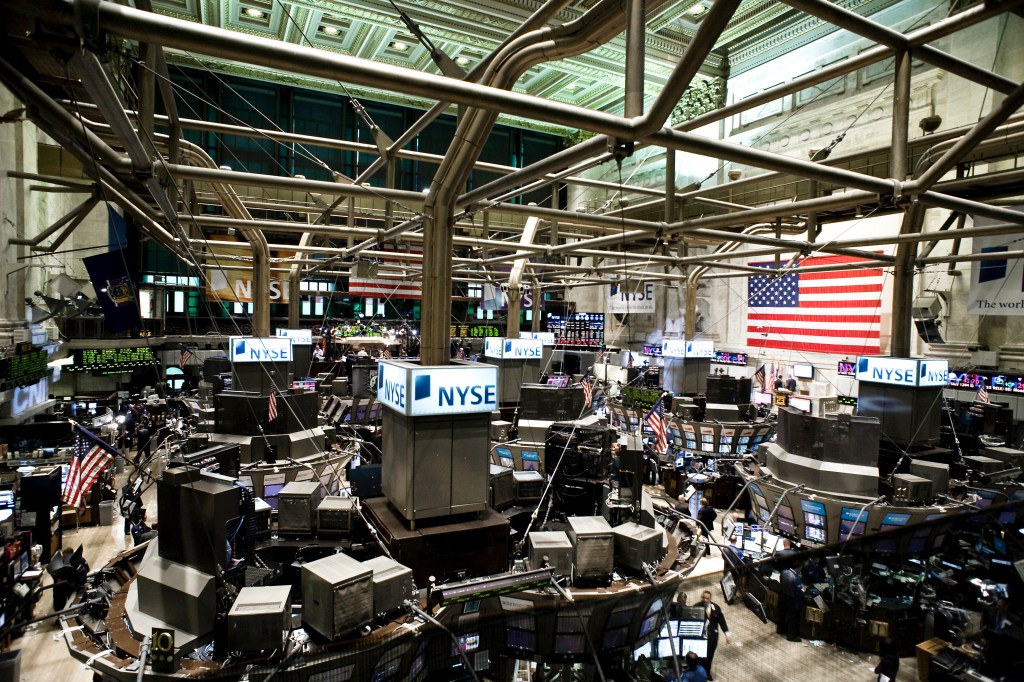
Image – Abhisit Vejjajiva
Article reviewed by an anonymous professor at New York University
The S&P 500 is a stock market index tracking 500 of the largest companies in America. Recently, analysts from some banks have reported conflicting year-end price targets for the index amid uncertainty surrounding President Trump’s tariff policies. While conflicting price targets are normal, these targets in particular highlight multiple very different market scenarios. But what even is a tariff and why is it affecting the stock market?
Tariffs are a tax that countries have to pay to sell their goods to another country. According to the Associated Press, in this case, President Trump’s “Liberation Day Tariffs” aimed to impose a 10% baseline tariff on nearly all countries, and for countries the United States has the largest trade deficits with, additional “reciprocal tariffs”. President Trump’s goal with these tariffs was to bring manufacturing back to the United States and to bring in hundreds of billions in new revenue to the government. So why are these tariffs affecting the stock market?
If a foreign company has to pay a tariff to export their products to the United States, they will generally increase the price of the products to cover the cost of the tariff. This forces American companies to pay more money to import materials and goods from other countries. In turn, American companies either lose profits, creating less attractive earnings reports to stockholders, or instead increasing the price of products on American consumers, which increases inflation. Inflation is when a currency becomes less valuable, so American consumers have less purchasing power. With less consumer purchasing power, consumer spending reduces, hurting the profits of many companies, both domestic and foreign. With decreased demand for foreign companies’ products, trade decreases, further slowing economic growth and resulting in lower corporate earnings. Furthermore, inflationary pressure created as a result of tariffs can result in central banks such as the Federal Reserve increasing interest rates. While increased interest rates combat inflation, it also makes borrowing money more costly. These factors, among many others, all play into the effects of tariffs on the stock market. However, in a Capital Market Outlook by Merrill on June 9, their Macro Strategy Team argues that “building deflationary pressures overseas are likely to weigh on import prices, creating conditions for a smaller inflationary impact from tariffs than is expected”.
As of market close on July 8, the S&P 500 was $6,225. Bank of America analysts raised their year-end target to $6,300 on that same day, which while being an increase, remains a relatively conservative change from current prices. Goldman Sachs analysts also recently raised their target to $6,600, a more aggressive positive forecast relative to the others. On the other hand, as of July 1, JPMorgan analysts forecasted a negative target $6,000.
“In the week following President Trump’s Liberation Day announcements, the S&P 500 fell over 12%, a decline not typically seen so quickly outside of extreme events like COVID and the [Global Financial Crisis]. In the weeks since President Trump announced 90-day delays on reciprocal and China tariffs, the S&P 500 has risen 19%” according to a chart published by MUFG Capital Markets strategists in May. It is impossible to predict the market, but there is economic data at play here that could help to determine whether the S&P 500 will continue to increase in value, a trend the market has followed ever since Trump announced those 90-day delays on tariff rollouts, or whether market stagnation and potentially a decline in value is more likely to occur. This 90-day period ended on July 9, and President Trump has extended the deadline, stating that these country-specific tariffs will go into effect on August 1 if trade agreements cannot be made, noting that no further extensions will be made. According to a new chart published by MUFG Capital Markets strategists in July, “Comprehensive trade agreements can take years to negotiate. Following the 90-day delay of the April 2nd reciprocal tariffs on April 9th, the Trump Administration signaled hopes for 90 trade deals in 90 days. Thus far, three major trade frameworks have been announced…Even with these three agreements, a relatively high level of tariffs has been maintained in each case”. This is particularly worrying when investor desensitization to these threats is considered, threats which may have very real economic impacts in the near future. “If there is confidence that negotiations will continue or deadlines will be extended, markets may continue to shake off the headlines” said Bret Kenwell at eToro. According to Rita Nazareth at Bloomberg News, “Kenwell noted that if investors feel the trade situation could become “more bite than bark,” we could very well see another pullback in stocks”. So how can we try to determine what’s next?
What happened in April might be the blueprint for what’s about to happen in August. Since high levels of tariffs are being maintained even with trade agreements, it is logical to assume the same worries investors had in April are relevant once again today, so it is likely that these tariffs will have negative impacts on the stock market when they go into effect. According to Emily Avioli, Vice President and Investment Strategist at Merrill, “the same big Technology stocks that pulled the index to the brink of bear market territory in April are the ones that helped to pave the path to recovery. The [Apple, Amazon, Alphabet, Nvidia, Meta, Microsoft, and Tesla] cohort alone was responsible for just under half of the S&P 500’s 19% gain since April 8…we maintain our neutral view in the near term on tariff uncertainty, elevated valuations, a broadening profits cycle, and recent Artificial Intelligence (AI) developments that generated a correction”. An important consideration to note is that certain industries are disproportionately affected by these tariffs, including pharmaceuticals, automobiles and related components, metals, and investigations by the U.S. Department of Commerce are currently underway that may result in tariffs on semiconductors and computer chips, aircrafts and related components, trucks, timber and lumber, and critical minerals as well. Given these risks, why are analysts at some banks more optimistic than others on their year-end S&P 500 targets?
According to David Kostin, chief US equity strategist at Goldman Sachs Research, “The forecast change reflects our economists’ projections of earlier and deeper [interest] rate easing from the [Federal Reserve] and projections for lower bond yields, continued strength in the largest stocks, and investors’ willingness to tolerate likely near-term weakness in company earnings…In addition to the improved outlook for interest rates, the strength of first quarter earnings results boosted our confidence that the largest stocks will sustain current investor expectations for their long-term growth for at least the next few quarters, helping support valuation for the aggregate S&P 500 index”. Kostin also notes that the effects of tariffs may take time to show up since large companies appear to have spare inventory in anticipation of higher tariffs. Furthermore, companies listed on the S&P 500 “plan to use a combination of cost savings, supplier adjustments, and pricing to offset the impact of tariffs” according to Kostin. So if the effects of tariffs can be mitigated to an extent, why are analysts at some banks making negative forecasts?
“It is the substantial shift in U.S. trade policy that has delivered the principal surprise, and we anticipate this shock to generate a broad-based downshift in global growth and a rotation in inflation pressures toward the U.S.”, said Bruce Kasman, Chief global economist at JPMorgan. Reflecting the concern in global business sentiment, the probability of a recession is currently pegged at 40%. Researchers at JPMorgan note that also playing into that probability is an “elevated risk of additional negative shocks”, including an expectation of tariff rates to once again increase and conflict in the Middle East threatening to disrupt the price of oil. Mislav Matejka, head of European & International Equity Strategy at JPMorgan adds that “A 40% recession probability is not insignificant…We are looking for weaker activity over the next few months, but also higher inflation prints in the U.S., which could squeeze purchasing power. Even with dramatic backpedaling, the current tariff picture is worse than most thought at the start of the year. Now, investors have likely been surprised by the strength of the equity rebound over the past two months, but these considerations need to be digested”. Calmingly, researchers at JPMorgan have noted that despite warning sentiment, the business sector is still healthy, citing profit margins in developed markets remaining close to record highs, and traditional signs of business sector vulnerability in America such as leverage and restricted access to funding and credit not being evident at this time.
In conclusion, these conflicting forecasts, with Goldman Sachs’ optimism at a $6,600 year-end target to JPMorgan’s choice to err on the side of caution with a $6,000 target, reflect an uncertain market. Corporate resilience, tariff workarounds, and potential interest rate cuts suggest that the economy may be in strong enough condition to handle the shock of tariffs. On the other hand, persistently high tariff rates and their disproportionate impact on industries critical to the American economy as well as a 40% risk of recession suggest underlying vulnerabilities that could potentially have detrimental economic impacts come August 1. Earlier this year in January, Morgan Stanley’s Global Investment Committee repeatedly urged investors to seek maximum portfolio diversification in 2025, citing policy uncertainty as one of the drivers of this stance, and that is proving more relevant than ever today.
Sources:
- Trump announces sweeping new tariffs to promote US manufacturing, risking inflation and trade wars – Associated Press – 4/3/25
- Looking Past the Tariff Impasse – Merrill – 6/9/25
- Why 2 More Experts Raised their S&P 500 Targets on Tuesday – Investopedia – 7/8/25
- Mid-Year Outlook – JPMorgan – 7/1/25
- Markets Complete Post-Liberation Day Round Trip (Though Still Below Peak) – MUFG – 5/21/25
- US Tariffs: What’s the Impact? – JPMorgan – 7/8/25
- The Trade War is Back (Though it Never Went Away) – MUFG – 7/10/25
- Stocks Hit a Wall as Trump’s Remarks Lift Copper: Markets Wrap – Bloomberg – 7/7/25
- Section 232 Investigations – United States Department of Commerce – Accessed 7/12/25
- The S&P 500 Is Projected to Rally More Than Expected – Goldman Sachs – 6/11/25
- Outlook 2025: The Case for Portfolio Diversification – Morgan Stanley – 1/22/25

 Policy Scope
Leave a comment